Reading Response Week
of 9/24-9/26
Craig, Understanding
Augmented Reality (Chapter 3 – Augmented Reality Software) and
Costello, Multimedia Foundations (Chapter
4 – Visual Communication)
Can’t
say I was too keen on Craig’s chapter for this week. There were, however, a few
passages or concepts that stood out to me, so I’d like to delve further into one
here. On page 80, Craig discusses the role of compasses as a sensor for
tracking. His words prompted me to recall a recent article featuring iOS7 updates. Along with the new mobile operating system came nifty
updates for the compass app. In sum, Apple’s compass app now serves a double
purpose – users have access to a level. Alas, technology has done it again;
now, consumers can rid their levels and rely on their trusty iPhones for
ensuring that surfaces are level and pictures are hung at proper angles. While
this isn’t in respect to AR, it is an example of how technology (and the smart
phone aka our hardware for AR) is impacting our day-to-day.
I
was more intrigued with Costello’s chapter on visual communication. In
discussing color, one of the main elements of design, Costello references the
movie Catch Me If You Can and its use
of color throughout the film to assist in character and plot development. This
done in several movies, and thought I’d share some of those instances here:
 Pleasantville,
the 1998 film staring Reese Witherspoon and Toby Maguire – Jennifer
(Witherspoon) and twin bother David (Maguire) play two completely opposite
twins. Jennifer is the rebel type, whereas David goes by the books. One
evening, after fighting over which TV program to watch, the twins are
transported into a TV program, Pleasantville,
where the twins become Bud and Mary Sue Parker in the 1958 black-and-white
sitcom. During their time in Pleasantville, the scenery changes from
black-and-white to color as the characters are exposed to new-age lessons, ideas,
etc. Color becomes vibrant and vivid, the timing and placement of its use are
critical to film and character development, and it’s used to indicate
irrevocable change.
Pleasantville,
the 1998 film staring Reese Witherspoon and Toby Maguire – Jennifer
(Witherspoon) and twin bother David (Maguire) play two completely opposite
twins. Jennifer is the rebel type, whereas David goes by the books. One
evening, after fighting over which TV program to watch, the twins are
transported into a TV program, Pleasantville,
where the twins become Bud and Mary Sue Parker in the 1958 black-and-white
sitcom. During their time in Pleasantville, the scenery changes from
black-and-white to color as the characters are exposed to new-age lessons, ideas,
etc. Color becomes vibrant and vivid, the timing and placement of its use are
critical to film and character development, and it’s used to indicate
irrevocable change. 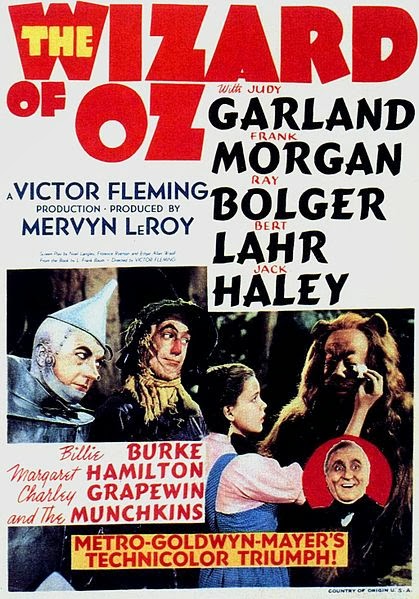
 Sin City,
the 2005 crime action film staring Bruce Willis and Jessica Alba – The film is
based on Frank Miller’s graphic novel and takes place in a series of parts.
While I haven’t seen the film myself, I’ve heard it on a must-watch list in
terms of the way color is used. Reviews suggest that the use of red and blue is
very powerful.
Sin City,
the 2005 crime action film staring Bruce Willis and Jessica Alba – The film is
based on Frank Miller’s graphic novel and takes place in a series of parts.
While I haven’t seen the film myself, I’ve heard it on a must-watch list in
terms of the way color is used. Reviews suggest that the use of red and blue is
very powerful.
The Wizard of Oz,
the 1939 Metro-Goldwyn-Mayer classic staring Judy Garland – The film is noted
for its use of Technicolor, and its bright colors cannot be mistaken when used
in combination with black-and-white scenes. This film actually incorporate
 s
several other notable vis comm principles
of which Costello refers to in his chapter, including: contrast, depth, proportion
and figure-ground.
s
several other notable vis comm principles
of which Costello refers to in his chapter, including: contrast, depth, proportion
and figure-ground.
 s
several other notable vis comm principles
of which Costello refers to in his chapter, including: contrast, depth, proportion
and figure-ground.
s
several other notable vis comm principles
of which Costello refers to in his chapter, including: contrast, depth, proportion
and figure-ground.
The Secret Garden,
the 1949 film is the second adaptation of the 1909 novel – The film appears in
black-and-white for the majority of scenes; however, the scenes set in the
garden appear in Technicolor. This use of color highlights the eroticism of the
film, further illustrating the special nature of Mary Lennox’s character, as
played by Margaret O’Brien.
These
color techniques, as they are addressed in the readings, go hand-in-hand with
our class conversation on subtractive and additive color.
Sources:
Costello, V.
(2012). Visual communication. Multimedia
foundations: Core concepts for digital design (95-126). Boston: Elsevier.
Craig, A. B.
(2013). Augmented reality concepts. Understanding
augmented reality: Concepts and applications (39-67). New York: Elsevier.
Omermus, W. “The
niftiest iOS7 feature you haven’t found yet.” Slate. 21 September 2013. Retrieved on September 24, 2013, from http://www.slate.com/blogs/future_tense/2013/09/21/ios7_tips_compass_app_secretly_has_a_level_and_it_s_addictive.html
Pleasantville (film). (n.d.). In Wikipedia. Retrieved September 24, 2013, from http://en.wikipedia.org/wiki/Pleasantville_%28film%29
Sin City (film). (n.d.). In Wikipedia. Retrieved September 24, 2013, from http://en.wikipedia.org/wiki/Sin_city_film
The Secret Garden (1949 film). (n.d.). In Wikipedia. Retrieved September 24, 2013,
from
The Wizard of Oz (1939 film). (n.d.). In Wikipedia. Retrieved September 24, 2013,
from http://en.wikipedia.org/wiki/The_Wizard_of_Oz_%281939_film%29

No comments:
Post a Comment